
International Humanitarian Law and its Effectiveness
- Rakkan Alhumaymidi
- Oct 30, 2020
- 4 min read
It is important here to start with a definition of The IHL; broadly it is a set of rules which seek, for humanitarian reasons, to limit the effects of armed conflict. The definition clearly points out the ultimate objective of IHL which is to protect human beings in wartime. In respect of the definition, a question might be raised, what creates the international humanitarian law. Since IHL is part of the international law, the latter is a set of rules governing international relations among states, the former sets its rules in several sources. The major source is Geneva Conventions 1949. International customary rules also play quite a role with maintaining armed conflicts as such customs are legitimized by states. By skimming the rules of the IHL, two main principles might be detected, the principle of humanity and the principle of military necessity. The first principle conducts restrictive military means and methods in wartime in order to protect civilians' lives. The second principle urges belligerent states to use legitimate weapons and tactics to overpower its enemy.
Consequently, the IHL is precisely a law that only applies on armed conflicts and aims to protect civilians in the time of war. Additionally, it is fundamental to define the term "civilians", and how they are protected by the IHL. There are a few definitions in this respect differing by which the context is. Therefore, the perfect definition in this context is "civilians are persons who are not member of the armed forces. The civilian population comprises all persons who are civilians."
Moreover, the IHL rules extend the definition of civilians to cover even the combatants who are no longer members of the armed force. It is clear that every person who is not involved
to the armed conflict or is not considered a combatant by the IHL, and even a soldier who stops being a part to the armed conflict is contained by the protection under the definition of civilians. It should be noted, there is an exception to the IHL definition, but this piece is not meant to argue such exceptions.
In terms of IHL protection for civilians in wartimes, it would be worthwhile to narrow
the discussion to Geneva Convention (IV) 1949 which relates to Civilian Persons in Time of War (The Convention), Protocol (I) 1977 which relates to the Protection of Victims of International Armed Conflict (The Protocol I) and finally Protocol (II) 1977 which relates to the
Protection of Victims of Non-International Armed Conflict (The Protocol II). The Convention in part II, article 13, covers a wide range of protection for all inhabitants of the countries in the conflict without any distinction of race, religion, political opinions, etc. Moreover, article 3 extends the protection even more to compel non-international characters, which mean rebels, dissidents and/or armed groups, to respect civilians' rights. The protocol (I) in article 48 imposes obligations on the parties in conflict to always distinguish between civilians and combatants and between civilians' objects and military objectives. While the scope of The Protocol (II) is set in article 1 (1), which applies to respect civilians' rights in all armed conflicts either international characters or non-international characters, and article 13 generally asserts full protection for civilians against military operations.
Although the military operations have been restricted by decent objectives, principles, conventions and protocols, ICRC is concerned whether the modern wars are intentionally
targeting civilians. A mind-blowing report was revealed by ICRC which indicates a total shift in modern wars:
The research reveals, in essence, that modern wars have become conflicts without limits.
Civilians have "both intentionally and by accident" been moved to centre stage in the
theatre of war, which was once fought primarily on battlefields. This fundamental shift in the character of war is illustrated by a stark statistic: in World War I, nine soldiers were killed for every civilian life lost. In today's wars, it is estimated that ten civilians die for every soldier or fighter killed in battle.
Moreover, statistics have shown horrible numbers of civilian deaths in war times including children. The Statista Report Department (SRD) published on 12th October 2020, a chart that shows the numbers of civilian deaths in Iraq's war by military operations; numbers are simply
inhumane.
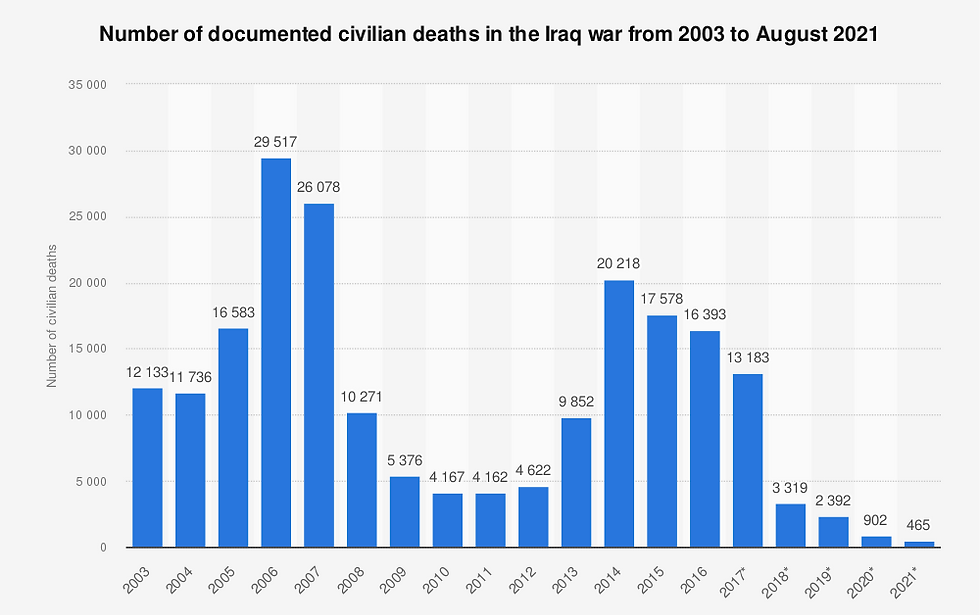
While both parties of conflict were in a state of war which means they were obligated and
complied by Geneva Conventions 1949, particularly the US, the numbers do not reflect respecting civilian lives. SRD has also published a report that shows how Russia airstrikes between 2015 to 2016 killed more civilians than rebels or dissidents.
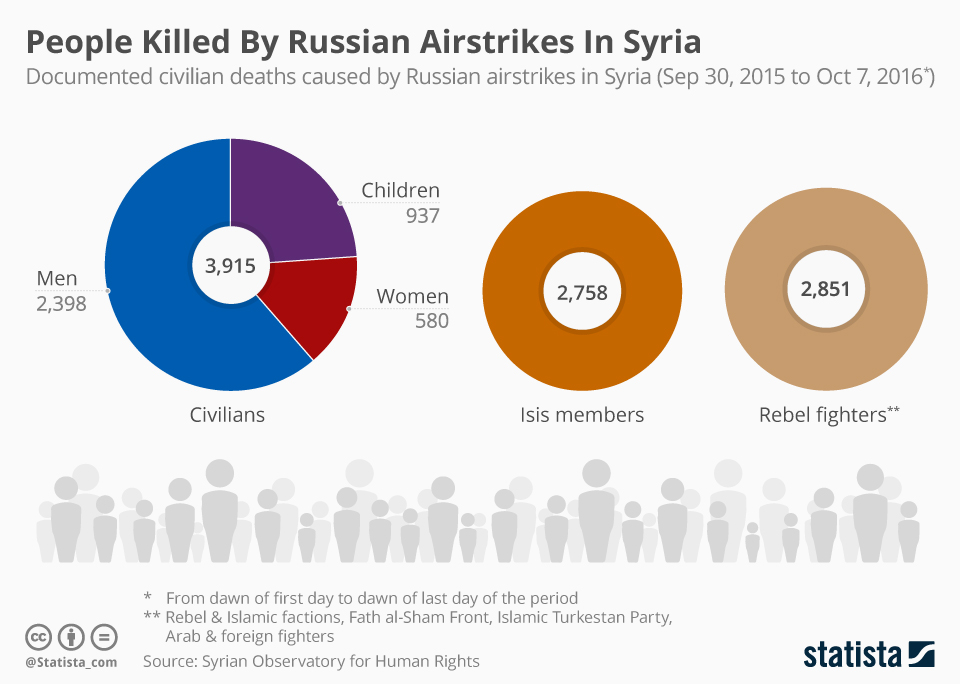
It is clear that civilians in Syria were a gainful target for the Russian military objectives, even
though the airstrikes, in a concept of belligerence, should have been targeting armed forces not innocent people.
These statistics and ICRC reports make almost every layman wonder, if the conventions and
customary rules are applied, if the ethical aspects of wars are perceived, and if the global leaders even try to beautify some of the inhumane political conflicts. There is no one justifiable reason making a solder kill an innocent civilian, while there are seven reasons compelling a solder not to kill a civilian:
First, killing non-combatants is impermissible because they have done no wrong.
Second, they do not take part in the fighting.
Third, they are not capable of defending themselves.
Fourth, it is not militarily necessary to kill noncombatants.
Fifth, exempting non-combatants from harm reduces the overall casualties of war. Sixth, protecting women and children makes species survival possible.
Seventh, killing non-combatants is against the "war convention".
In conclusion, it has been shown the principle, objectives and definition of IHL, and how far IHL provisions assert and admit protection of civilians, yet some belligerents may not respect, in many occasions, these provisions. That raises many concerns about whether the IHL has been exploited by belligerents to avoid international responsibilities and therefore international sanctions, whether parties of a conflict gambling on provisions to deceive international observers, whether not breaking IHL exempts belligerents from ethical aspects and sense of humanity in the battlefield.
It is unfortunate to come to conclusion without an answer or giving any explanations. I will leave you here with a twist that might be seen an answer; what if the globe went back to square one and deregulated armed conflicts, would that encourage armed forces to lie on common sense and an ethical ground while they are fighting?


Comments